
This article is part of RLE’s cross-study meta-analysis series. Building on Capgemini’s Generative AI in Organizations report (2024), we explore what rising investment levels in Generative AI really mean for engineering. While global corporations now dedicate over $150 million annually to GenAI, the decisive factor for ROI is not the budget itself, but how effectively AI is embedded into engineering workflows, simulation ecosystems, and product development cycles.
Budgets Are Rising – But So Are the Questions
Capgemini’s analysis shows a clear correlation between company size and investment: mid-sized firms commit around $85 million to generative AI initiatives, while enterprises with revenues above $20 billion invest close to $158 million annually.
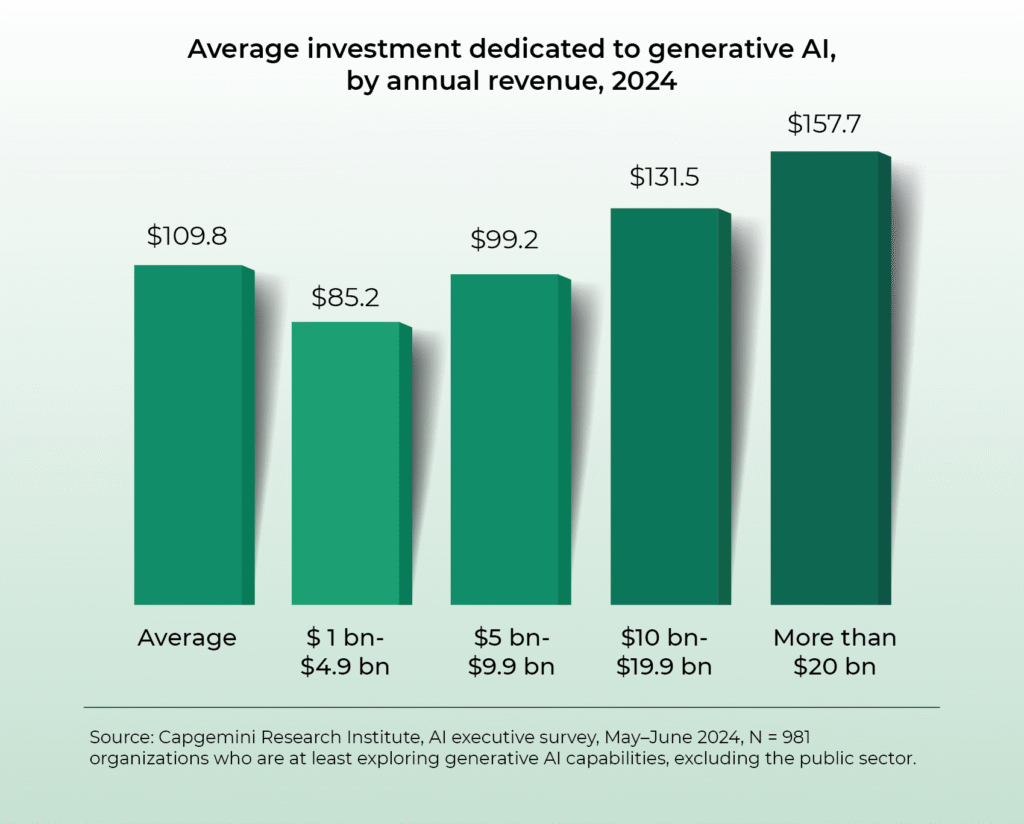
At first glance, these numbers suggest that larger budgets naturally deliver greater returns. Yet the reality in engineering-heavy industries is more nuanced. Investment alone does not guarantee value. What matters is whether funds are directed toward use cases that accelerate development, strengthen product quality, and improve resilience.

What Investment Levels Really Reveal About Readiness
Looking at these clusters through an engineering lens reveals a deeper truth: the leaders of tomorrow are not those who spend the most, but those who structure their investments around maturity and scalability.
Generative AI can only transform development if it is integrated into core engineering processes:
- Feeding AI into simulation loops to validate lightweight designs under crash and manufacturability constraints.
- Automating test case generation to reduce validation bottlenecks.
- Linking AI-powered optimization with digital twins, ensuring virtual results translate into real-world performance.
Without this integration, investments risk becoming “proof-of-concept spending” – budgets consumed without measurable engineering impact.
Engineering Relevance: Turning Capital into Capability
This is where the Capgemini findings reach their strategic depth. The curve of investment is not just about financial power, but about engineering readiness.
Large enterprises face complex portfolios with ICE, hybrid, and BEV platforms, multiple E/E architectures, and diverging regulatory demands. Throwing money at GenAI will not resolve that complexity. What delivers value is the ability to weave AI into the engineering fabric – so that design iterations shorten, risk management improves, and quality rises without spiraling costs.
At RLE, we see this shift directly in customer projects. Instead of exploratory pilots, OEMs and Tier 1s increasingly demand scalable frameworks: modular AI setups that can plug into existing toolchains and deliver efficiency across vehicle domains.
AI That Works for Your Projects
Practical, scalable, and designed to deliver measurable results.
RLE’s Perspective: Smart Scaling in Practice
Our expertise lies in translating abstract AI potential into concrete engineering outcomes. Examples include:
- AI-driven test automation that accelerates validation cycles by weeks.
- Generative design integration with simulation workflows, balancing lightweighting, crash safety, and manufacturability.
- Partnerships with Synera to enable connected engineering workflows, where AI and simulation results flow seamlessly across CAD, CAE, and PLM environments.
For us, the metric of success is not how much is spent on GenAI – but how much engineering complexity is reduced, how many cycles are saved, and how reliably concepts reach production.

Outlook: From Spending to Scaling
The investment curve is real, and budgets for generative AI will continue to grow. But the winners will not be those with the largest numbers in their annual reports. They will be the companies that transform capital into capability – building AI-enhanced engineering ecosystems that are fast, resilient, and scalable.
What this means in practice is that the ROI of GenAI will not be measured in the size of the investment, but in the maturity of its integration. Engineering organizations that align AI with simulation workflows, validation processes, and platform strategies will be able to shorten development cycles and reduce portfolio risk, even as complexity increases.
Generative AI is therefore no longer a budget line item. It has become an engineering decision – one that determines how quickly an OEM can adapt to shifting markets, how robustly it can validate new architectures, and how efficiently it can bring ideas from concept to production.
