
As part of RLE’s cross-study meta-analysis series, this article takes a closer look at Capgemini’s 2024 report “Harnessing the Value of Generative AI.” The findings show that productivity and customer satisfaction are the most immediate gains from GenAI adoption, while cost savings remain limited in the early stages. We connect these insights to the engineering context, showing how RLE helps transform short-term improvements into scalable, long-term value for product development and mobility.
The Real Benefits Behind the Numbers
Capgemini’s study “Harnessing the Value of Generative AI” (2024) surveyed nearly 1,000 organizations exploring or deploying GenAI. The results are telling: average improvements included +7.8% productivity, +6.7% customer engagement & satisfaction, and +5.4% operational efficiency. Gains in sales reached +4.4%, while direct cost reductions trailed at just +3.6%.
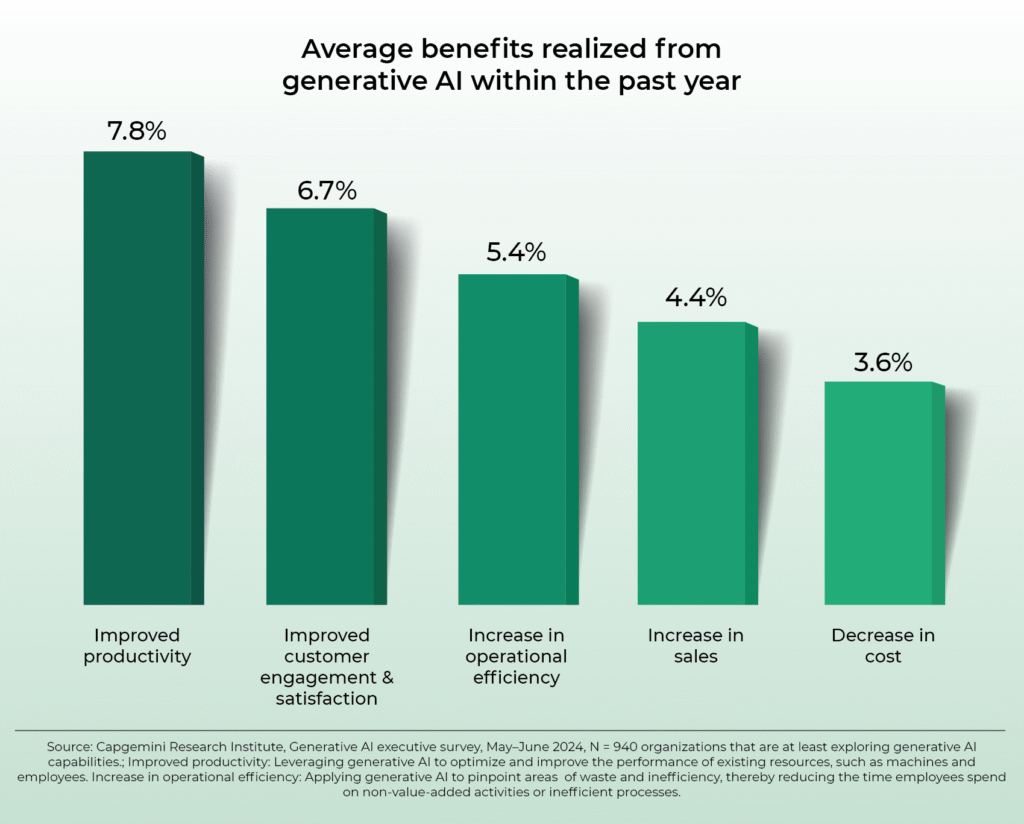
At first glance, this may seem surprising. Isn’t AI often sold as a cost-saving tool? But in engineering, the picture is more nuanced. The numbers confirm what practitioners already see: Generative AI is not about instant savings but about reshaping workflows, shortening development cycles, and enabling higher quality at scale.

Rethinking Productivity in Engineering
For many industries, productivity means reducing headcount. In engineering, it means something different: shortening iteration loops and freeing experts from repetitive work.
At RLE, we see this in projects where AI-based test automation replaces thousands of manual validation steps. Instead of engineers spending time on repetitive checks, Generative AI models generate, prioritize, and evaluate test cases automatically. This shifts engineering productivity from quantity to quality — accelerating cycles without compromising rigor.
The +7.8% productivity boost highlighted by Capgemini isn’t just about efficiency. It reflects a structural change in how engineering teams approach complexity.
“While the average productivity improvement from generative AI stands at 7.8%, some organizations have already achieved up to a 25% boost over the past year.”
– Capgemini Research Institute, “Generative AI in Organizations” (2024)
Bridging Productivity and Satisfaction
What makes the Capgemini results especially relevant for engineering is the interdependence of productivity and customer satisfaction. Faster internal cycles directly translate into external value: when engineers validate designs more quickly, OEMs can make earlier go/no-go decisions, reduce uncertainty in program planning, and avoid late-stage redesigns. This agility not only lifts internal efficiency but also strengthens client confidence — a benefit that does not appear as a line item in cost but is decisive for competitiveness.
Turning AI Potential into Engineering Impact
From simulation to validation: discover how we apply Generative AI to accelerate real engineering workflows.
Translating Customer Satisfaction into B2B Engineering
Customer satisfaction might sound like a consumer metric, but in B2B engineering it has its own meaning. For OEMs and Tier 1 suppliers, satisfaction comes from:
- Faster validation of concepts that reduces decision-making risk.
- More reliable design outcomes through integrated simulation and digital twins.
- Confidence in supplier capabilities, knowing that workflows are scalable and robust.
This is where collaboration matters. For example, RLE’s integration of Synera’s automation platform into simulation workflows enables real-time feasibility checks and optimization across multiple design alternatives. For clients, that translates directly into higher trust and smoother collaboration — which the Capgemini study captures under “customer engagement & satisfaction.”

Why Cost Savings Should Not Be the First Metric
The study’s results make clear that direct cost reductions remain modest at this stage. That’s not a failure but the natural curve of technology adoption in engineering.
Early-stage investment goes into:
- Training AI models on domain-specific data.
- Building scalable infrastructure.
- Integrating GenAI into complex toolchains (CAD, CAE, PLM).
The payoff comes later, once workflows are standardized and knowledge is reused across programs. At RLE, we help clients bridge this gap by designing modular AI frameworks that deliver value across projects, not just in isolated pilots.
Cost will follow but only if the focus stays on building scalable engineering ecosystems rather than chasing short-term savings.
Resilience as the Hidden ROI
Beyond measurable KPIs, Generative AI also builds resilience into engineering organizations. By embedding AI into simulation, testing, and design processes, companies reduce their exposure to talent bottlenecks, late-stage errors, or sudden regulatory changes. In an environment where product complexity and time-to-market pressures increase simultaneously, resilience is itself a return on investment. RLE supports OEMs and Tier 1s by creating workflows that are robust enough to absorb these shocks — making engineering not just faster, but safer and more predictable.
Outlook: From Benefits to Long-Term Value
The Capgemini study offers a reality check: the most immediate gains of Generative AI in engineering are not about cutting budgets but about boosting performance and resilience. In practice, that means shortening development cycles, validating designs earlier, and reducing the risks that typically surface late in the process. This is exactly where RLE’s engineering approach connects: by embedding GenAI into simulation, validation, and platform strategies, we help OEMs and Tier 1s turn early productivity gains into lasting performance.
Over time, these shifts naturally lead to cost benefits — but more importantly, they create the foundation for long-term competitiveness. Organizations that focus only on direct savings risk underinvesting in the capabilities that matter most: faster time-to-market, greater robustness, and the ability to scale expertise without scaling headcount linearly. From our perspective at RLE, Generative AI is not a cost-cutting tool, but a strategic lever for building engineering workflows designed for resilience, adaptability, and scale.
