
Consumer preferences for propulsion technologies are diverging: while European and Chinese markets are shifting strongly toward BEVs, U.S. consumers still show a preference for ICE vehicles. These differences don’t just shape sales figures – they redefine engineering priorities for OEMs and suppliers worldwide.
This article is part of RLE’s cross-study meta-analysis series. Based on Deloitte’s Global Automotive Consumer Study 2025, we examine how these consumer insights translate into concrete challenges for vehicle development – from platform flexibility and weight optimisation to digital engineering workflows.
A Market Pulling in Different Directions
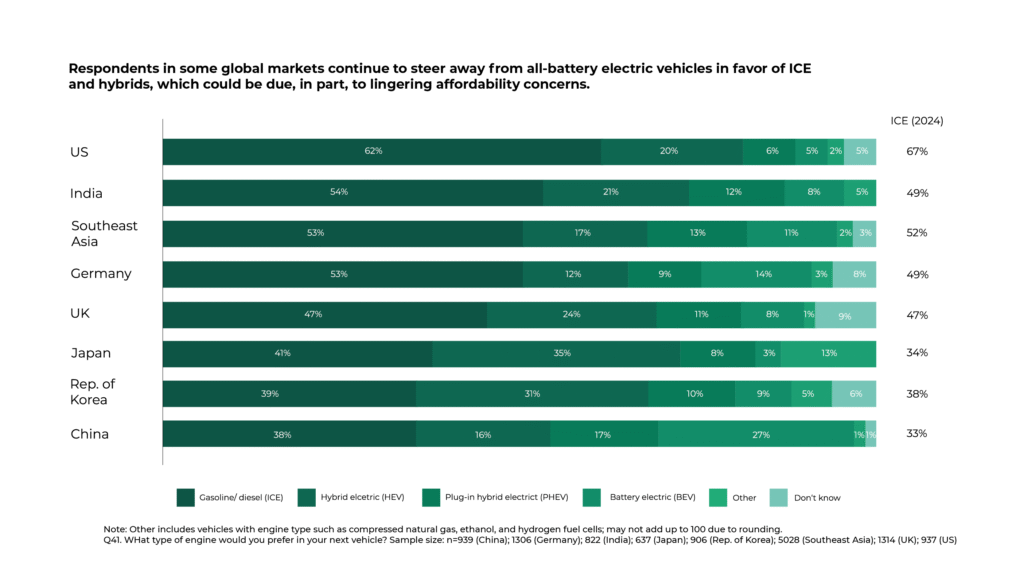
Global automotive markets are no longer aligned. Deloitte’s latest Global Automotive Consumer Study shows how propulsion preferences diverge sharply across regions: while consumers in Germany and China lean strongly toward battery-electric vehicles (BEVs), buyers in the U.S. still show high attachment to internal combustion engines (ICE).
On the surface, this looks like a consumer story. But for OEMs and suppliers, it is first and foremost an engineering challenge: How do you develop vehicles that remain competitive when customer expectations and regulatory frameworks point in opposite directions?

Diverging Markets - One Industry
The divergence is not simply about selling different products in different regions. It is about managing parallel technology pathways in the same global industry.

- Germany / China: high BEV adoption driven by regulation, incentives, and charging infrastructure.
- U.S. / Other markets: ICE remains dominant, with hybrids playing the role of transitional technology.
- Emerging economies: infrastructure gaps keep ICE relevant far longer.
This diversity creates the risk of engineering fragmentation: multiple architectures, duplicated R&D, and stretched supply chains. The winners will not be those who “guess right” about the future of propulsion, but those who can engineer across uncertainty.
From Consumer Choice to Engineering Complexity
Every shift in consumer demand cascades directly into technical consequences. Multi-energy platforms now have to accommodate ICE, hybrid, and BEV drivetrains with as little redundancy as possible. At the same time, electrical and electronic architectures are becoming more complex, as they must support increasingly diverse control systems across propulsion types. On the production side, manufacturing systems are expected to switch seamlessly between these variants without driving up cost or lead time.
In practice, this means engineering is no longer just about designing individual vehicles — it is about safeguarding the resilience of the entire product portfolio.
Want to see how modular vehicle development reduces complexity across ICE, hybrid, and EV?
Strategic Risks of One-Sided Bets
The temptation is strong to commit early to a single propulsion pathway, for example by going all-in on BEVs. Yet oversimplification is risky. A BEV-only approach might cause OEMs to miss out on markets such as the U.S. or parts of Asia where ICE demand remains significant. On the other hand, relying too heavily on ICE could leave manufacturers behind in regions accelerating electrification, potentially cutting them off from entire consumer bases.
The real strategic danger lies not in choosing the “wrong” technology but in adopting too narrow a focus. Engineering, therefore, becomes the hedge: modular platforms, scalable E/E systems, and advanced simulations are essential to reduce the cost and complexity of carrying parallel pathways.
“Automakers should expect to manage multiple propulsion systems for the foreseeable future, balancing consumer demand, regulatory pressures, and infrastructure realities..”
Deloitte, Global Automotive Consumer Study 2025
Engineering as Risk Management

This is where the study results take on their deeper meaning: Vehicle engineering has become risk management.
- Consumers express uncertainty in their propulsion preferences.
- OEMs mirror this uncertainty through complex, multi-path portfolios.
- The ROI of advanced engineering is not just faster development, but the ability to hedge against volatility.
Here, simulation-driven design becomes central. By integrating digital twins, virtual validation, and AI-assisted engineering, OEMs can anticipate trade-offs in weight, cost, and performance across propulsion types – without committing prematurely to one technology track.

How RLE Approaches the Challenge
At RLE, we see this not only as a technical task, but as a strategic one. Our teams work on:
- Multi-energy platforms that keep ICE, hybrid, and BEV options viable within one architecture.
- Simulation ecosystems (CFD, structural, E/E) that accelerate decision-making and reduce the risk of late design changes.
- Digital integration with partners like Synera, enabling automated workflows and rapid iterations across engineering disciplines.
This is not about predicting which propulsion system will dominate in 2030. It is about building the engineering backbone that keeps all options viable – so OEMs can adapt as consumer sentiment and regulation evolve.
Where We Go from Here
The Deloitte study shows us the surface: diverging consumer preferences. The deeper insight is this: the future belongs to OEMs who treat engineering not as product development, but as portfolio risk management.
Those who can manage complexity, hedge against uncertainty, and pivot quickly will not just survive consumer volatility – they will turn it into competitive advantage.
