Capgemini’s 2024 report “Harnessing the Value of Generative AI” highlights a major frontier: the transition from simple chatbots to autonomous multi-agent systems. But what looks like a clean evolution on paper is, in practice, a fundamental redesign of how AI integrates into engineering. This article unpacks what AI agents really are, why the hype is justified—and where engineering expertise is essential to make them work.
- Chatbots vs. AI Agents: Defining the Real Difference
- The Engineering Perspective: Why Autonomous Agents Fit Complex Engineering Workflows
- Multi-Agent Systems as a Model for Cross-Domain Collaboration
- Applying Agent Principles in RLE’s Connected Engineering
- The Road Ahead: Adoption of AI Agents in Industry
Chatbots vs. AI Agents: Defining the Real Difference
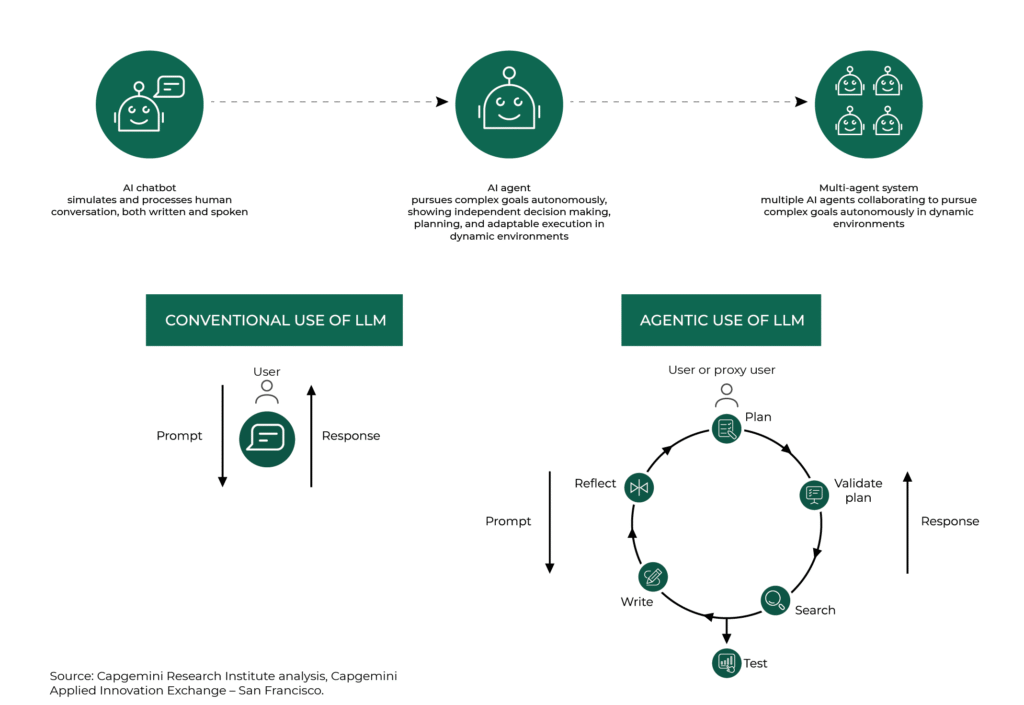
Traditional LLM-based chatbots simulate conversation and return a single answer to a user prompt. Useful, but inherently limited. AI agents take this a step further: they can pursue higher-level goals independently, plan actions, validate outputs, and iterate until a task is fulfilled.
In engineering, that distinction is crucial. Instead of asking “What’s the optimal geometry for this part?” and receiving a single suggestion, agents can explore alternatives, test constraints, and refine results in loops—mirroring how an engineer would approach the problem.
The Engineering Perspective: Why Autonomous Agents Fit Complex Engineering Workflows
Engineering workflows don’t end at producing an answer; they demand validation, simulation, and compliance checks. AI agents can embed these steps into autonomous loops. Imagine a digital assistant not only proposing a CAD variant, but also running a crash simulation, evaluating thermal behavior, and iterating until performance targets are met.
For OEMs and Tier 1s under constant cost and time pressure, this means fewer manual handovers, shorter iteration cycles, and a better balance between speed and quality.
“AI agents go far beyond simply generating answers from data. Their real strength is in orchestrating entire workflows, taking over repetitive tasks, linking tools, and iterating designs, so that engineers can spend more time on what really matters: solving complex problems and driving innovation.”
– Florian Schumacher, Manager Strategy and Corporate Development, RLE International
Multi-Agent Systems as a Model for Cross-Domain Collaboration
While a single AI agent can support repetitive tasks, the real potential lies in multi-agent systems. Just as engineering projects rely on cross-functional collaboration, agent teams can distribute responsibilities across specialized domains:
- A design agent generating geometry.
- A simulation agent validating crash or CFD performance.
- A cost agent ensuring design-to-cost principles are met.
- An integration agent aligning outputs across the workflow.
This mirrors RLE’s own Connected Engineering approach, where mechanical, electrical, and software domains are tightly linked. The difference: agents don’t just connect tools, they continuously interact—accelerating decision-making across the entire development process.
Smarter Engineering with AI Agents
RLE integrates agent-based AI into digital development processes, supporting OEMs and suppliers boost efficiency, quality, and scalability.

Applying Agent Principles in RLE’s Connected Engineering
AI agents don’t replace engineering expertise—they amplify it. At RLE, we experiment with agent-like orchestration in Synera-based workflows: integrating topology optimization, CFD analysis, and simulation loops into automated chains. The agentic principle is already visible here: tools that “talk” to each other, iterate automatically, and deliver results ready for expert evaluation.
This ensures that autonomy is balanced with domain knowledge, safety standards, and regulatory compliance. In engineering, “smart” without “safe” is not an option—and that’s where our expertise makes the difference.
The Road Ahead: Adoption of AI Agents in Industry
Capgemini reports that over 80% of organizations expect to adopt AI agents within the next three years (Capgemini, 2024). The decisive factor will not be the technology itself, it already exists but the way it is embedded into engineering-grade environments.
For RLE, this evolution is not a threat to engineers but an opportunity: agent systems allow global teams to scale expertise, accelerate complex workflows, and maintain competitive advantage in a fragmented mobility landscape. AI agents are not about replacing human insight—they are about multiplying its reach.
