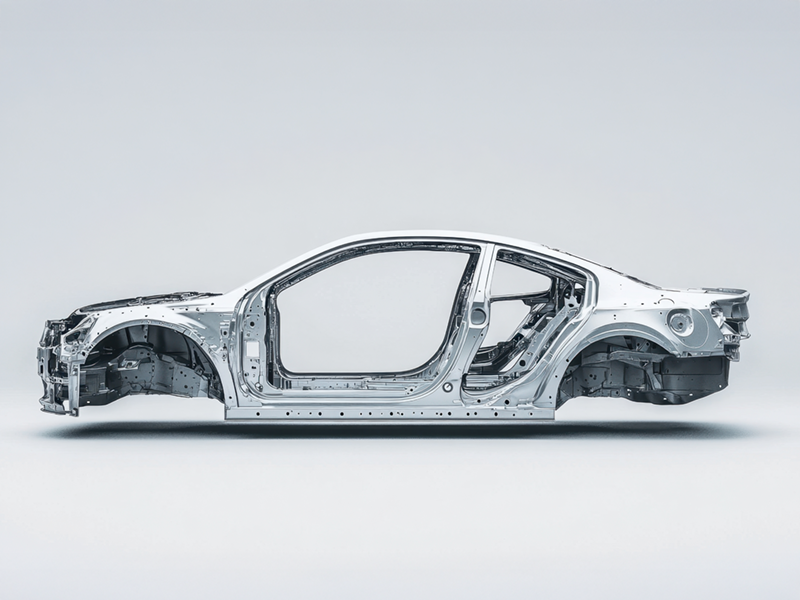
In collaboration with Handtmann Casting, RLE conducted a feasibility study on giga casting for a rear-end module. The objective: demonstrate maximum feasible casting design, benchmark it against conventional structures, and quantify potential weight and part count reduction. The results highlight not only the opportunities of giga casting but also the technical boundaries engineers must address.
- Why Weight Optimisation Matters in Giga Casting
- From 96 Components to One: The Baseline
- Study Objectives
- Methodology and Engineering Approach
- The Key findings
- Implications for Engineering Practice
- RLE’s Role in Giga Casting Innovation
- Conclusion: A Step Towards Industrial ApplicationConclusion: Local Relevance is Engineered. Not Translated.
Why Weight Optimisation Matters in Giga Casting
Giga casting has become one of the most discussed manufacturing innovations in the automotive industry. By replacing multiple smaller parts with large aluminium castings, OEMs and Tier 1 suppliers can achieve significant efficiency gains in cost, assembly time, and structural performance. Yet, the real challenge lies in weight optimisation: how can a casting be designed to deliver maximum weight savings without compromising stiffness or crash performance?
To address this, RLE partnered with Handtmann Casting in an innovation study focused on the rear end module of a vehicle platform. The objective was clear: explore how far weight and part count could be reduced through a single giga casting while maintaining full structural integrity.

From 96 Components to One: The Baseline
The baseline of the study was a traditional welded rear-end module consisting of 96 individual components. Such assemblies are common in conventional body structures but add complexity in production, welding tolerances, and quality assurance.
The giga casting approach radically changes this setup: instead of 96 parts, the target was a consolidated structure manufactured as a single casting. This shift is not just about production efficiency – it redefines the balance between design freedom, structural performance, and manufacturability.
Study Objectives
The joint innovation study with Handtmann set out with three clear targets:
- Weight potential: How much can be saved by replacing a welded structure with a single casting?
- Design strategies: What ensures stiffness, crashworthiness, and manufacturability
- Workflow efficiency: How can simulation accelerate concept-to-casting validation?
Methodology and Engineering Approach
The engineering workflow was structured to ensure feasibility under realistic boundary conditions:
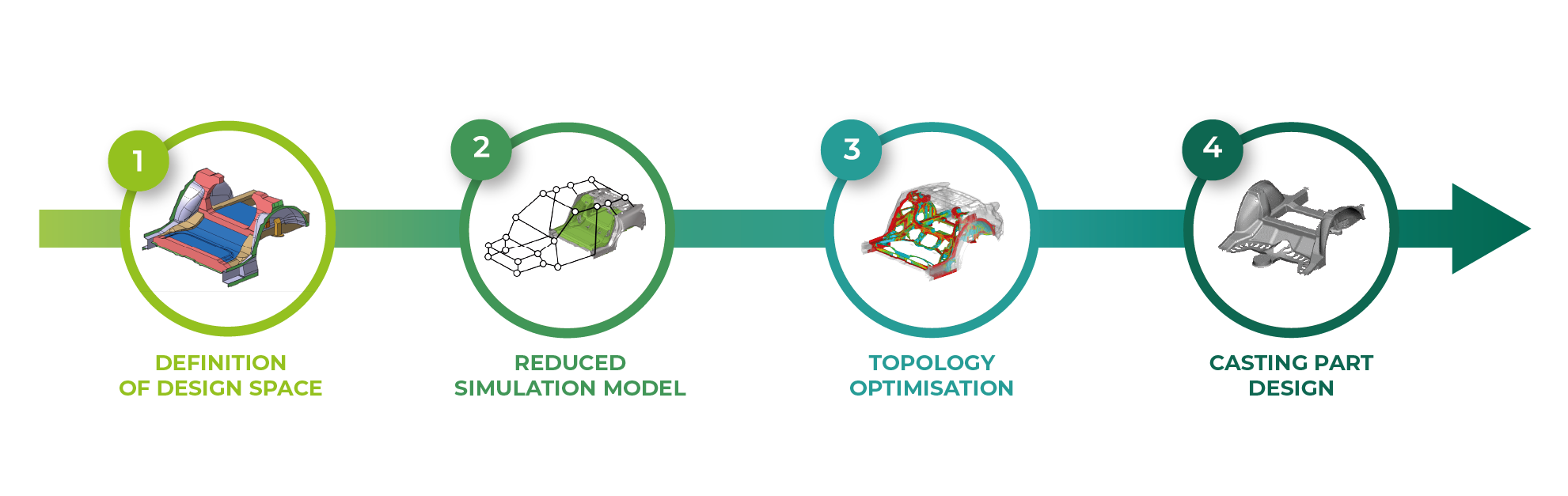
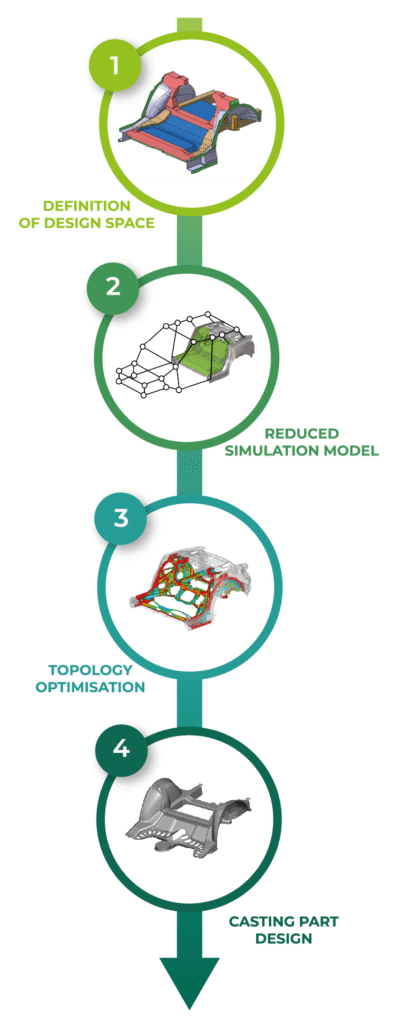
- Design space definition: Establishing geometric limits for the giga casting to ensure compatibility with adjacent systems.
- Topology optimisation: Identifying the optimal material distribution while targeting stiffness and crash performance.
- Surface modelling & CAD transfer: Interpreting the topology results into a castable geometry.
- Casting simulation: Validating manufacturability with Handtmann’s foundry expertise.
- Structural assessment: Analytical evaluation of stiffness and crash behaviour.
This end-to-end approach allowed us to benchmark giga casting not only as a theoretical lightweight strategy, but as a manufacturable engineering solution.
The Key findings
The study confirmed that giga casting of the rear-end module is technically feasible – but also exposed important engineering trade-offs:
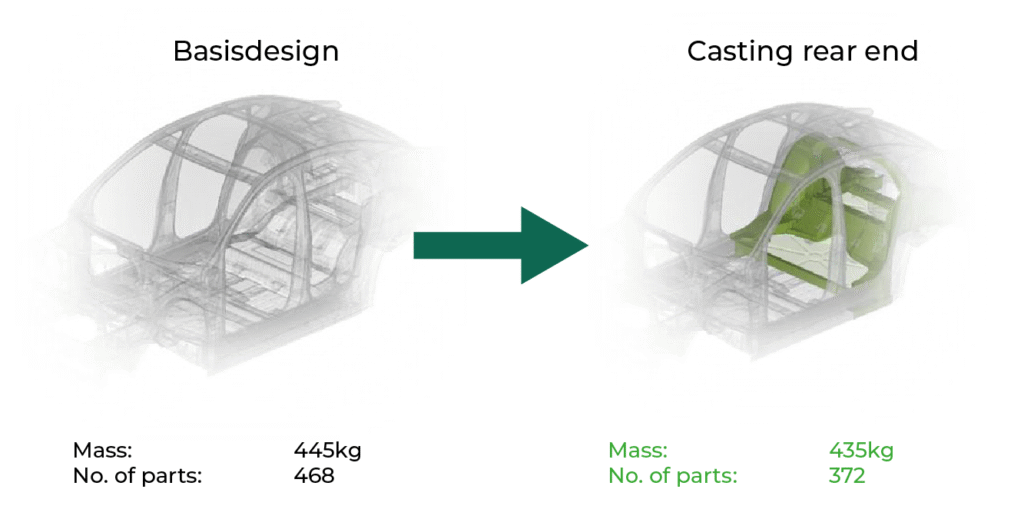
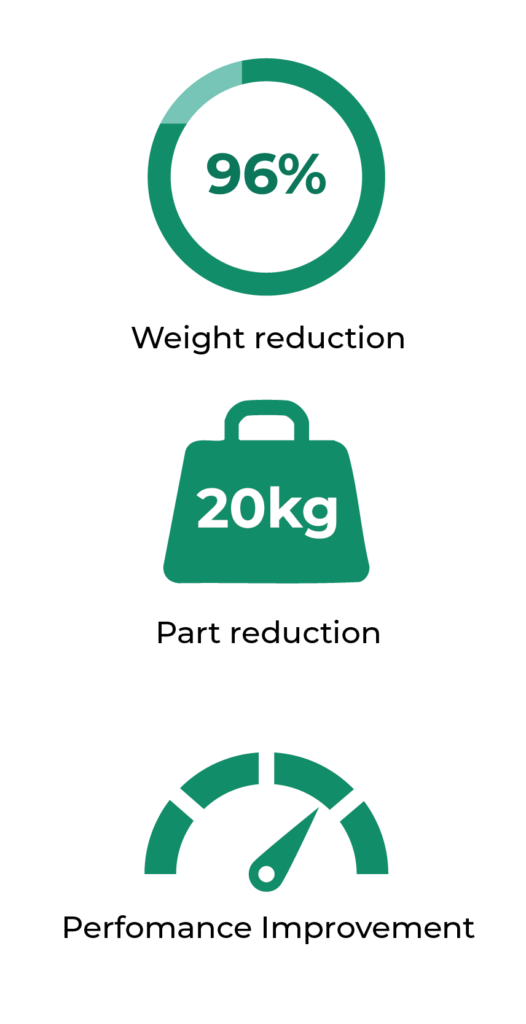
- 20 kg weight saving was achieved against the reference design.
- 96 parts consolidated into a single casting, significantly reducing joining complexity.
- Crash and stiffness requirements were met within the feasible design envelope.
At the same time, casting constraints introduced limitations in geometry optimisation. Certain reinforcements required by crash KPIs could not be fully realised within a single casting, underlining the importance of integrating manufacturing feedback early in the optimisation loop.
Implications for Engineering Practice
The results highlight both the potential and the boundaries of giga casting for structural modules:
- The part count reduction is a strong driver for cost and process simplification.
- Weight reduction, while measurable, is less dominant compared to the integration effect.
- The interplay between topology optimisation and casting feasibility is critical – pure digital optimisation without foundry constraints would lead to unrealistic designs.


RLE’s Role in Giga Casting Innovation
RLE’s contribution went beyond simulation. By combining lightweight design expertise with crash validation and manufacturability know-how, we ensured the study results were not only theoretical but grounded in industrial practice.
Our role as a development partner is to connect the innovative design space opened by giga casting with the practical requirements of OEM programs. This collaboration with Handtmann demonstrates that balance – delivering results that are both ambitious and feasible.
Learn More about RLE's services in Giga Casting
Interested in how RLE supports OEMs and Tier 1s in scaling giga casting into next-generation vehicle programs?
Conclusion: A Step Towards Industrial Application
The RLE-Handtmann study demonstrates how giga casting can transform a traditionally welded assembly into a single feasible component with clear benefits in production efficiency and structural performance.
The findings also illustrate the need for close collaboration between engineering service providers and casting specialists. Only by combining design optimisation, crash performance analysis, and manufacturing simulation can giga casting move from concept to industrial reality.
