
This article is part of RLE’s cross-study meta-analysis series. We analyze leading studies and enrich them with our engineering perspective. Based on Capgemini’s 2024 report “Generative AI in Organizations”, we explore how the investment wave in Generative AI has evolved into 2025 and what it takes to move from budgets to real impact in engineering.
From Experimental Budgets to Core Strategies
Generative AI has moved beyond the hype stage. In 2024, Capgemini’s “Generative AI in Organizations” found that enterprises with revenues above $20 billion were already investing an average of $157 million annually into GenAI initiatives. At the time, many companies were still in pilot phases – testing tools for code generation, document handling, or basic design automation.
Fast forward to 2025: those budgets are no longer exploratory. AI investment has become part of core engineering and product development strategies, especially in mobility and manufacturing. For OEMs and Tier 1s, the conversation has shifted from “Should we invest?” to “How do we ensure ROI – fast?”
At RLE, we see this shift reflected directly in project demands. Instead of proof-of-concept requests, clients increasingly ask for scalable frameworks – modular GenAI setups that can plug into engineering workflows and deliver measurable efficiency gains.

The Scale of Investment in GenAI and What It Really Means
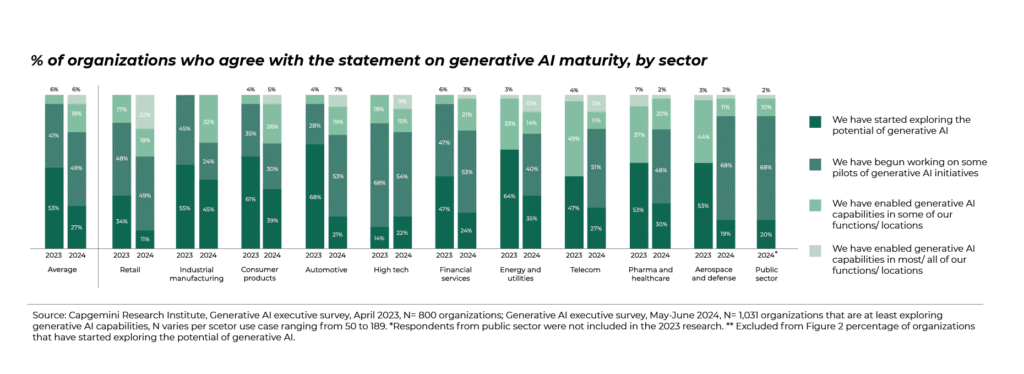
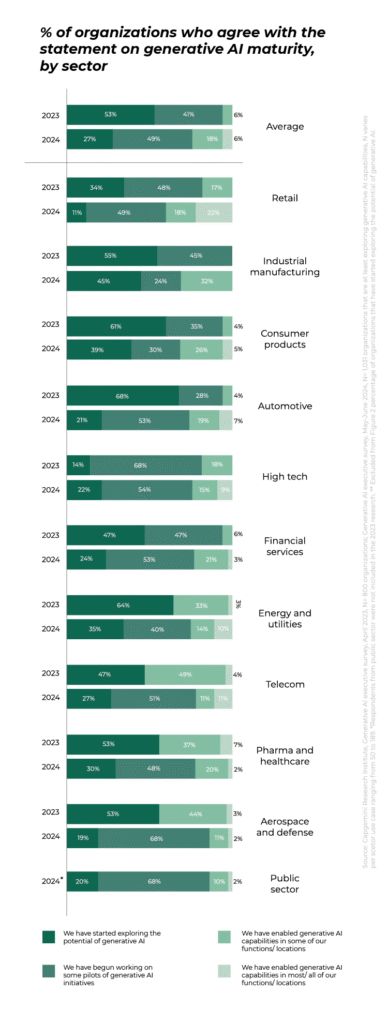
Capgemini’s survey showed that 96% of large organizations had increased GenAI budgets by late 2024, with the automotive sector among the leaders. But the raw numbers can be misleading: high spending doesn’t automatically translate into business value.
At RLE, we’ve observed that successful programs share a few common traits:
- Integration into engineering processes rather than isolated pilots
- Domain-specific adaptation (e.g., CAD, NVH, or simulation data models)
- Governance frameworks that ensure quality and traceability
- Human-in-the-loop design to keep engineering expertise at the center
Budgets are the enabler but the real differentiator is execution.
The Engineering Multiplier: From Cost to Capability
The value of GenAI is not limited to cost savings. In engineering, its true multiplier effect lies in cycle time reduction and decision confidence.
Take design optimization: instead of manually testing hundreds of geometry and weight scenarios, machine learning models can propose viable solutions within hours. Or consider digital twins: with AI integration, they move from static replicas to predictive development tools

At RLE, we’ve helped OEMs cut prototype loops in half by embedding AI into simulation workflows.
This isn’t just about faster results. It’s about freeing engineers to focus on high-value tasks – system integration, safety, sustainability – while AI handles the complexity behind the curtain.
AI That Works for Your Projects
Practical, scalable, and designed to deliver measurable results.
Risks and Realities of Generative AI in Engineering in 2025
Growing budgets don’t erase the obstacles. According to Capgemini, only a minority of companies currently reach scaled AI deployment. Key challenges include:
- Governance gaps: unclear ownership slows progress
- Data quality issues: inconsistent or siloed datasets limit reliability
- Domain expertise: generic AI models often fall short in engineering contexts
- Trust and transparency: black-box outputs can block adoption
At RLE, we address these by embedding domain-specific expertise into every AI use case. That means tailoring solutions not just to data availability, but to engineering logic and safety standards.

Outlook: 2025 and Beyond
2025 is shaping up to be the year when GenAI either delivers on its promise in engineering – or risks being remembered as another overhyped technology wave.
From our perspective at RLE, the deciding factor is clear: value emerges when GenAI is embedded into modular, scalable engineering strategies. The future belongs to those who can combine:
- strategic investment with pragmatic use cases
- AI-driven acceleration with domain-specific expertise
- global innovation with local engineering needs
The bottom line: Budgets create momentum. But only engineering-led integration turns that momentum into measurable performance.
